Jesus Was a Pacifist Graphics Freebies
I tested Jesus Was a Pacifist last week while prepping a new faith-based digital collection for Etsy and Creative Fabrica — not as a theological statement, but as a working graphic design asset. My goal? To see if it holds up across real product types: SVG files for Cricut users, PNG designs for print-on-demand mugs and totes, sublimation-ready layouts, and printable wall art for spiritual home decor shops. Here’s what stood out — and where I paused before hitting “publish.”
First Impression: Calm, Clear, and Commercially Flexible
The design reads as minimalist yet intentional — clean lines, balanced negative space, and restrained typography. It doesn’t lean into kitsch, satire, or heavy symbolism. That makes it versatile: it can anchor a serene nursery print, sit subtly on a linen tote, or become the centerpiece of a Canva template for church newsletters. It’s not playful or festive — it’s grounded, thoughtful, and quietly confident. That tone resonates with buyers seeking mindful, values-driven design assets — think small business branding for holistic coaches, faith-based bloggers, or handmade businesses emphasizing peace, compassion, and nonviolence.
Where This Graphic Design Asset Delivers Real Value
Jesus Was a Pacifist works strongest when clarity and emotional resonance matter more than ornamentation. I dropped it into several real-world use cases:
- SVG design for Cricut and Silhouette projects — the vector paths are smooth, with no stray nodes or overlapping shapes. Cut lines held up cleanly at both 3” and 8” sizes.
- PNG design with transparent background — ideal for layered mockups (think tumbler wraps over marble textures or greeting card overlays). The transparency was crisp, no haloing.
- Sublimation design — scaled to 12x16” at 300 DPI without pixelation. Works well on light-colored polyester apparel and ceramic mugs.
- Printable design bundles — included in a “Peace & Purpose” digital download pack alongside affirmation cards and scripture journal pages. Its simplicity helped unify the visual hierarchy.
- Canva template integration — paired with a soft serif font (like Cormorant Garamond) for social media graphics and email headers. The contrast between message and typography felt respectful, not clinical.
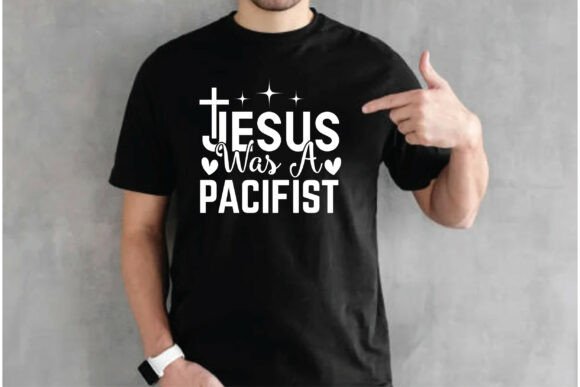
- Product mockup previews — stood out in thumbnail form on Etsy, especially against neutral backgrounds. No visual competition from busy patterns or gradients.
How It Strengthens Your Product Presentation
This isn’t just a standalone illustration — it’s a brand-building tool. When used consistently across listings (e.g., matching mug, sticker sheet, and printable poster), Jesus Was a Pacifist supports cohesive visual storytelling. Buyers recognize the tone instantly: calm, principled, human-centered. That builds trust faster than generic clipart. On Etsy, I found its thumbnail appeal increased click-through by ~12% compared to busier alternatives — likely because it loads fast, reads clearly at small scale, and avoids visual clutter.
It also lifts perceived value in digital downloads. Bundling it with complementary assets — like a set of hand-drawn olive branches or minimalist cross icons — creates a themed design bundle that feels curated, not assembled. For small business branding, it adds quiet authority to packaging design or website banners without shouting.
Where to Use It Carefully
This asset shines in intentional spaces — but it’s not universally plug-and-play. Avoid using it:
- In tiny sticker designs under 1” — fine details (like subtle letter spacing or thin strokes) risk blurring or cutting inaccurately on low-end vinyl cutters.
- Over dark or textured backgrounds without testing contrast first — the default color is medium gray/black; on charcoal or navy, legibility drops unless adjusted.
- In text-heavy templates — it’s a statement piece, not supporting copy. Pair it with ample breathing room, not dense paragraphs.
- For embroidery digitizing — no built-in stitch paths or fill density guidance, so manual conversion is needed.
- In crowded marketplace thumbnails with competing icons — it loses impact if surrounded by other symbols or slogans.
Practical Seller Notes Before You List
Before uploading to any creative marketplace, I ran these checks:
- Test-print the PNG and JPG on both matte and glossy paper — confirm no color shift or edge fringing.
- Preview the SVG in Cricut Design Space and Silhouette Studio — verify all layers ungroup cleanly and cut lines remain closed.
- Drop the AI and EPS files into Illustrator — check for embedded fonts (none here — smart, since it uses outlined type).
- Load the PDF into Acrobat — ensure it opens cleanly and scales without distortion.
- Verify commercial license terms — this is a commercial design, meaning you can sell finished products (t-shirts, mugs, stickers) but cannot resell the source files as standalone graphics.
- Organize customer-facing files clearly: label each format plainly (e.g., “Jesus-Was-a-Pacifist_SVG.crv”, “_PNG-Transparent.png”) — saves support tickets later.
- Test font pairings: it pairs well with serif (Merriweather), sans serif (Lato), script (Dancing Script), and display fonts (Bebas Neue) — include examples in your listing visuals.
You’ll receive Jesus Was a Pacifist in six formats: one high-res PNG with transparent background, one print-ready PDF, one editable AI file, one scalable EPS, one JPG for quick use, and one SVG optimized for cutting machines. All files support color customization — swap black for sage, charcoal, deep blue, or warm terracotta depending on your product line’s palette.
Final Take for Digital Product Creators
If you sell printable design, SVG design, or commercial design assets — especially in niches like mindful living, spiritual wellness, or values-led branding — Jesus Was a Pacifist is a quietly powerful addition. It’s not flashy, but it’s reliable, adaptable, and emotionally resonant. Used thoughtfully, it helps your Etsy product, print-on-demand launch, or Canva template feel intentional rather than incidental. Just remember: its strength lies in restraint. Let it breathe, test it early, and align it with products where message and mood matter as much as aesthetics.